Hello to all astronomy enthusiasts traveling around to enjoy the starry skies with your camping cars, and to those who are just starting to think about embarking on a stargazing journey!
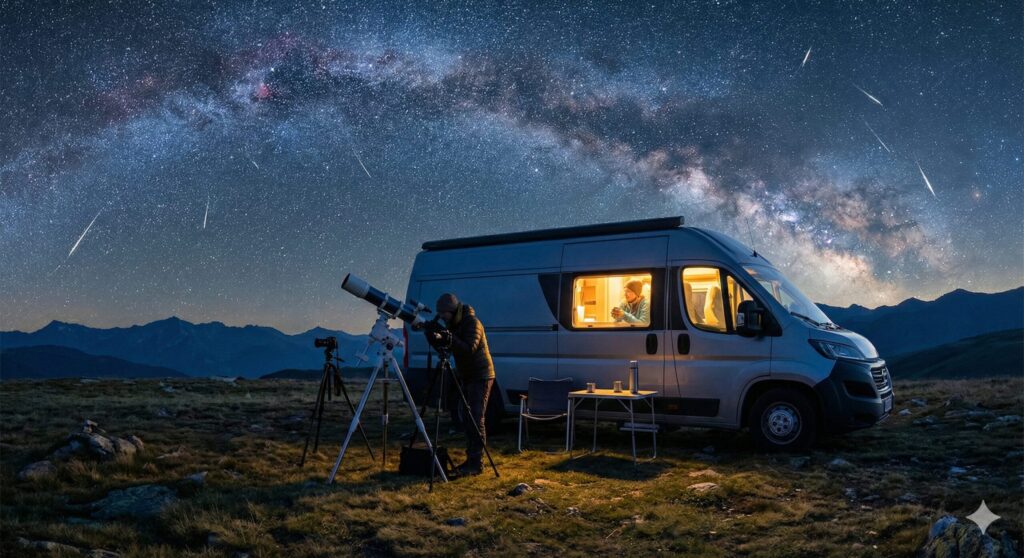
2026 will be a special year that astronomy fans won’t want to miss. The reason is that the Perseid meteor shower on August 13th coincides with a new moon – a rare and ideal condition. This is a perfect opportunity to observe even faint meteors without the interference of moonlight. Additionally, there will be several “planet parades” visible throughout the year, making it a year packed with astronomical events.
With a camping car, you can transport your equipment to the best observation sites and enjoy the starry sky all night while staying warm inside the vehicle. This time, we’ll introduce recommended observation spots in the Kinki and Chugoku regions from a camping car traveler’s perspective.
Why Camping Cars Are Ideal for Stargazing
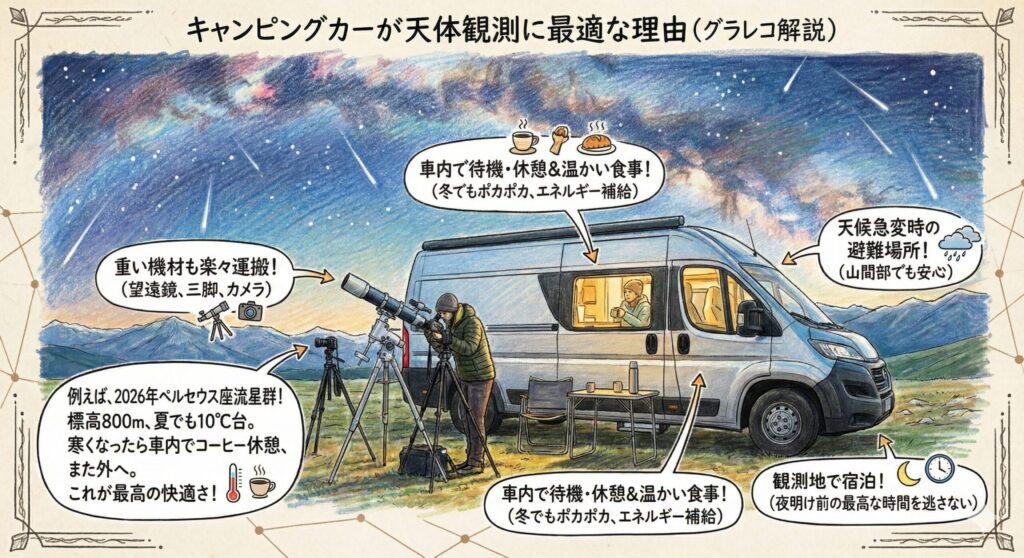
Serious stargazing requires going to places with minimal light pollution. Such locations are often in mountainous areas or highlands far from urban centers. With a camping car:
- Easy transport of heavy equipment: Telescopes, tripods, cameras, cold weather gear, and more
- Wait and rest inside the vehicle: No worries about freezing during winter nighttime observations
- Stay overnight at observation sites: Never miss the best viewing time before dawn
- Shelter during sudden weather changes: Peace of mind since mountain weather changes quickly
- Food and drinks always ready: Stay energized during long observation sessions
For example, during the Perseid meteor shower in August 2026, the peak is at 11:00 AM on August 13th (daytime), but the best observation time is from late night on the 12th to dawn on the 13th. At highlands over 800m elevation during this time, temperatures can drop to around 10°C even in midsummer. But with a camping car, when it gets cold, you can retreat inside for warm coffee and then head back out. This comfort level is unmatched by tent camping or regular car camping.
2026 Must-See Astronomical Events Calendar
Early January: Quadrantids Meteor Shower
- Peak: Around January 4th
- ZHR (Zenithal Hourly Rate): About 80
- Key Point: Observe in the clear winter air. Be fully prepared for cold weather
Mid-August: Perseid Meteor Shower [The Most Important Event of 2026]
- Peak: August 13th, 11:00 AM (JST)
- Moon Phase: 0 (New Moon) ← This is optimal!
- Observation Plan: Late night August 12th to dawn on August 13th is crucial
- Expectations: With zero moonlight, even faint meteors can be observed
Throughout the Year: Planet Parades
- Mid-June: Jupiter, Venus, Mercury (evening western sky)
- Early August: Mercury, Mars, Uranus, Saturn, Neptune (dawn eastern sky)
- Late September: Jupiter, Mars, Uranus, Saturn, Neptune (evening to midnight)
- Late November: Mercury, Venus, Mars, Jupiter, Uranus (early morning eastern sky)
December: Geminids Meteor Shower
- Peak: Mid-December (check for exact date)
- ZHR: About 80
- Key Point: Take advantage of winter’s clear skies for observation
Kinki Region Stunning Stargazing Spots [Prefecture Guide]
[Hyogo Prefecture] Where Technology Meets Nature
🌟 Tonomine Highland
Elevation: Approximately 800m
Camping Car Suitability: ★★★★★
Tonomine Highland in Kamikawa Town is one of the premier stargazing spots in the Kinki region, with vast grasslands spreading out. The 360-degree panoramic view makes it ideal for meteor shower observation.
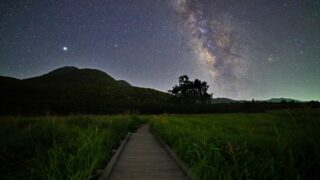
Actual Observation Experience: On a summer night, park your camping car at Tonomine Highland’s parking area, and the Milky Way stretches clearly overhead. During the August Perseid meteor shower, with a new moon, there’s zero moonlight. Spread out a leisure sheet and lie down, and in 30 minutes, you’ll see over 20 meteors streak across your field of view. When you get cold, go back inside the car for hot cocoa, then head out again. Due to the high elevation, even in midsummer, nights are around 15°C. Long sleeves are essential.
Access: About 1 hour by car from Himeji City
Notes: Completely dark at night. Unpaved roads present. 4WD recommended
Best Season: August (Perseids), January (Quadrantids)
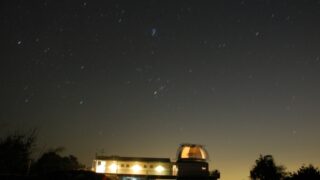
🔭 University of Hyogo Nishi-Harima Astronomical Observatory
Camping Car Suitability: ★★★★
A professional facility equipped with the “Nayuta Telescope” (2m aperture), one of Japan’s largest public telescopes. There are also accommodation facilities, and observation sessions are held late into the night.
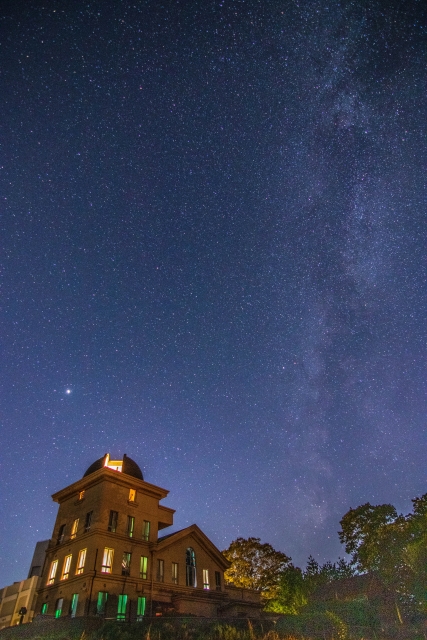
Actual Experience: Even beginners can easily operate the 60cm telescope to observe Saturn, and you’ll be moved by how clearly you can see its rings! With the Nayuta Telescope, you can observe detailed structures of nebulae and galaxies invisible to the naked eye. Park your camping car in the nearby parking lot, participate in the observation session, and then enjoy talking about the stars inside your vehicle.
Reservations: Observation sessions held nightly (check in advance)
Facilities: Accommodation, restaurant, parking lot
Recommended Observations: Planets, galaxies, nebulae
🏔️ Mineyama Highland
Elevation: Approximately 900m
Camping Car Suitability: ★★★★★
Mineyama Highland in Kamikawa Town, Kanzaki District, is a famous stargazing location in Hyogo Prefecture alongside Tonomine Highland. Hotel Relaxia and campgrounds are available, with well-developed infrastructure.
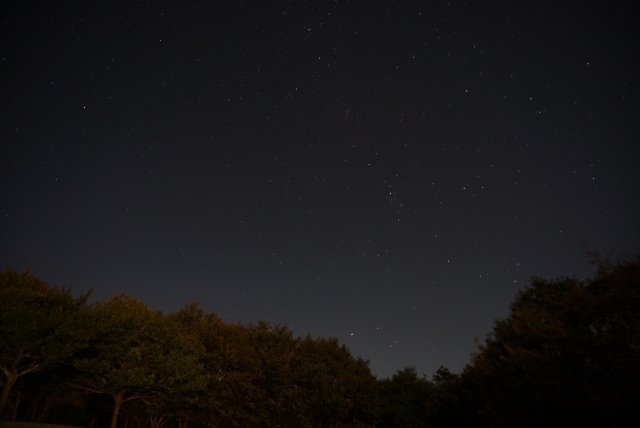
From a Camping Car Perspective: There’s a large parking lot around Mineyama Highland Hotel Relaxia where overnight camping car stays are possible (check in advance). The night view looking down from 900m elevation is spectacular, with the mountains of Tajima to the north and the faint lights of the Harima Plain to the south visible. Snow accumulates in winter, so studded tires are essential.
Best Season: May to November
Note: Possible road closures in winter
[Shiga Prefecture] Observation Bases Around Lake Biwa
🏕️ Hira Genki Mura
Elevation: Approximately 200m
Camping Car Suitability: ★★★★
An observation site with attached campground in the nature-rich area of Otsu City. With easy access of less than an hour from urban areas, it’s ideal for beginners and families.
Example Usage: On weekends, it’s just over an hour by car from Osaka. After arriving at the campground, enjoy the athletic course during the day, and after dinner, stargaze. Although the elevation is low, city light is subdued, and you can confirm the Milky Way. It’s an ideal environment for using a planisphere with children to find the Summer Triangle and the Big Dipper.
Note: Be sure to call ahead before visiting. The facility closes when storm warnings or landslide alerts are issued for northern Otsu City. Since the network is unstable, advance contact is essential.
Recommended For: Casual stargazing, beginners
Facilities: Campground, athletic course
🌊 Spots Around Lake Biwa
Camping Car Suitability: ★★★★
Northern and western Lake Biwa has numerous spots ideal for star photography with the lake surface as a foreground.
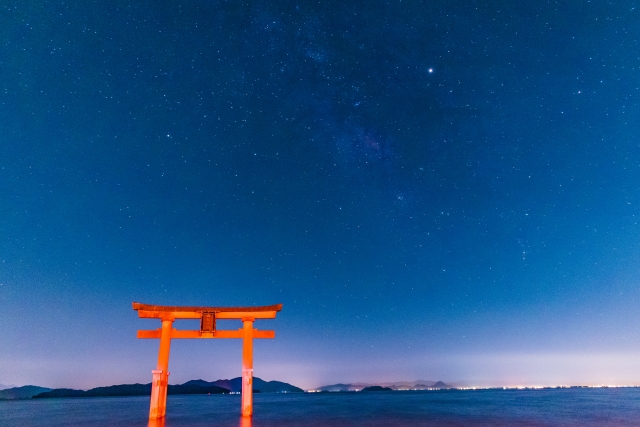
Photography Point Examples:
- Okubiwako Parkway: Panoramic view of Lake Biwa and starry sky from the observation deck in the northern lake area
- Makino Highland: Large parking lot, advantageous for northern sky observation
- Imazu Beach: Reflection photography of stars on the lake surface
From a Camping Car Perspective: Using roadside stations around Lake Biwa (such as Makino Okkaka Pass) as bases, enjoy the sunset over Lake Biwa in the evening and stargazing at night. Due to reflected light from the lake surface, it’s not suitable for extremely faint celestial objects, but it’s excellent for meteor showers, planetary observations, and star landscape photography. Don’t forget wind protection and dew prevention measures since it’s lakeside.
[Nara Prefecture] Strategic Use of Highlands and Parks
🌾 Soni Highland
Elevation: Approximately 800m
Camping Car Suitability: ★★★★
Located in Soni Village, Uda District, Nara Prefecture. Also famous as an autumn pampas grass viewing spot, you can enjoy both starry skies and scenery.
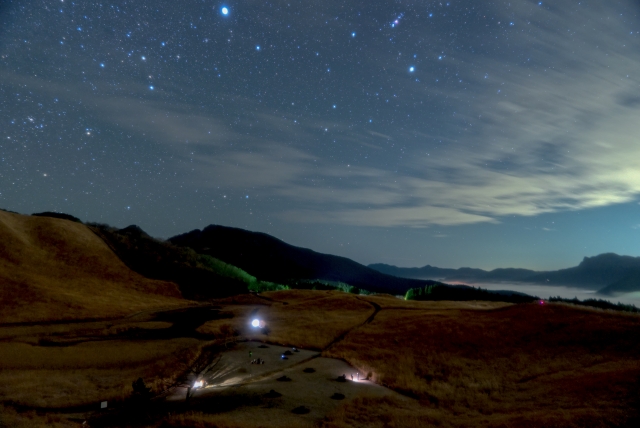
Actual Observation Experience: Visited during a new moon period in October, avoiding the full moon. During the day, stroll through the golden sea of pampas grass, and after sunset, it transforms into a star-filled sky. The open highland at 800m elevation offers a 360-degree view. In the clear autumn air, the Andromeda Galaxy is faintly visible to the naked eye. With binoculars, the blue-white stars of the Pleiades star cluster (Subaru) are beautiful.
Access: Bus or car from Kintetsu Nabari Station
Parking: Available (spacious)
Best Season: August (Perseids), September to November (pampas grass and starry sky)
🌲 Forest Park Konoyama
Camping Car Suitability: ★★★
Mt. Kono in Yamazoe Village is a top-ranked stargazing spot in Kansai. However, there are strict rules for using the facility.
Important Notes:
- Advance reservation required: Walk-ins not allowed
- Contact method: Phone calls are difficult to get through. Email or Facebook message contact is required
- Closure: Generally closed without advance notice
This strict system is to maintain a high-quality observation environment. If you can get a reservation, it’s the best environment, but if not, secure an alternative location like Soni Highland.
Planning Tips: Contact via email at least two weeks before your visit. Confirm the reply before departing.
[Wakayama Prefecture] High Transparency of the Kii Mountains
🏔️ Oishi Highland
Elevation: Approximately 870m
Camping Car Suitability: ★★★★★
On the border of Aridagawa Town and Kimino Town in Arida District, Wakayama Prefecture. One of the highest elevation observation sites in the Kinki region, offering an attractive 360-degree panoramic view.
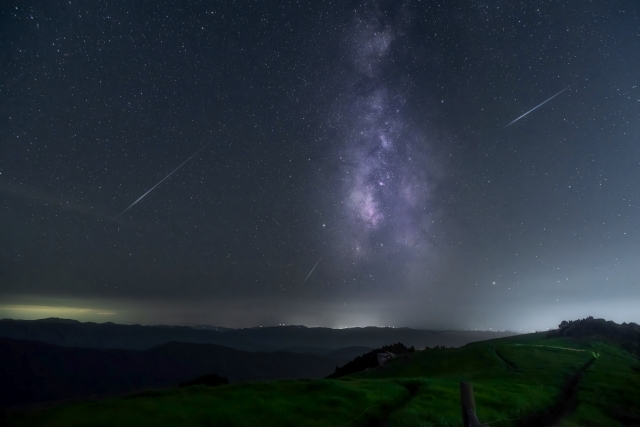
Actual Observation Scene: Early January, on the peak day of the Quadrantids meteor shower. Oishi Highland at 870m elevation is near freezing. Fully equipped with down jacket, gloves, and knit cap. At 2 AM, when the radiant point rises high, go outside. In the crystal-clear winter air, observe 10 meteors in 15 minutes. When you can’t stand the cold anymore, return to the camping car, warm up with the diesel heater while drinking hot soup. This “observe → rest” cycle is the true strength of a camping car.
Access: About 1 hour by car from Wakayama City
Parking: Spacious parking area available
Best Season: Autumn to winter (clear air), January (Quadrantids), August (Perseids)
Camping Car Privilege: Since there are few accommodation facilities at Oishi Highland, being able to spend the night in a camping car is a huge advantage. You won’t miss the best observation time before dawn.
🌊 Cape Shionomisaki
Camping Car Suitability: ★★★★
Cape Shionomisaki, the southernmost point of Honshu, has an absolute advantage for southern sky observation.

Observation Characteristics:
- Southern sky opens up: Southern constellations that are usually difficult to see in Honshu (Centaurus, parts of Southern Cross) are visible near the horizon
- Pacific Ocean horizon: Nothing blocking the view
- Scorpius and Sagittarius observation: The central part of the summer Milky Way rises high
Actual Experience: During a new moon period in July, park your camping car at Cape Shionomisaki’s parking lot and gaze at the southern horizon. At 10 PM, Antares in Scorpius glows bright red, and to its east is the densest part of the Milky Way (toward Sagittarius). Sweep with binoculars and countless nebulae and star clusters can be found. Since it’s coastal, dew prevention measures (lens heaters) are essential.
Facilities: Parking available near the Roadside Station “Shionomisaki Tourism Tower”
Note: Strong sea wind, dew prevention essential
[Kyoto Prefecture] Sea and Mountains of Tango Region
🌊 Tango Sea and Star Viewing Hill Park
Camping Car Suitability: ★★★
On the Tango Peninsula in Kyotango City. A hilltop facing the Sea of Japan, ideal for northern sky observation and photography combining the coastline and starry sky.
Observation Points:
- Photographing diurnal motion around Polaris
- Winter Orion and Sea of Japan collaboration
- Within walking distance from the parking lot
Camping Car Information: Use the park’s parking lot. Since it’s coastal, wind is often strong, so prepare windbreak measures for outdoor observation. Observing through the window from inside the car is also an option.
Chugoku Region Dark Sky Paradise [Prefecture Guide]
The Chugoku region has the Chugoku Mountains acting as a natural barrier blocking urban light, preserving extremely dark night skies.
[Okayama Prefecture] The Philosophy of Bisei
⭐ Bisei Astronomical Observatory & Starry Sky Park
Estimated SQM Value: 21.5+ (extremely dark)
Camping Car Suitability: ★★★★★
Bisei Town in Ibara City is one of the few places in Japan that has enacted a “Light Pollution Prevention Ordinance.” It boasts top-class darkness in the country.
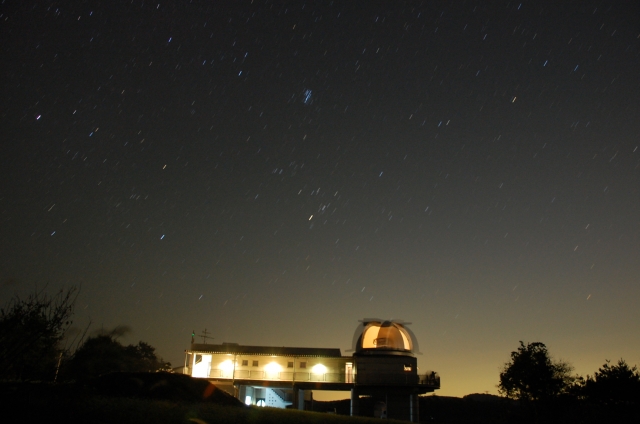
Bisei Town’s Philosophy: Bisei Town has intentionally sacrificed convenience to “protect dark starry skies.”
- No public restrooms at Starry Sky Park → Use the open-air market’s restroom
- Limited accommodation (1 pension, training facility, several campgrounds)
- Nearest proper hotels are in Ibara, Yakage, Takahashi (30 min by car), Kurashiki, Fukuyama (1 hour by car)
How to View This: It may sound inconvenient, but this thorough elimination of light pollution is what achieves the miraculous darkness of SQM 21.5+. With a camping car, toilet (portable), bed, food – everything is self-contained. This “inconvenience” is not a problem at all.
Actual Observation Experience: Late night August 12, 2026, the night before the peak of the Perseid meteor shower. Arriving at Bisei Town Starry Sky Park’s parking lot, streetlights are completely off (by ordinance, lights are turned off after 10 PM). Only red-filtered flashlights are used.
At 1 AM, as the radiant point begins to rise, observe over 40 meteors in one hour. The synergistic effect of a new moon (moon phase 0) and SQM 21.5+ darkness allows you to catch faint meteors that are usually invisible with the naked eye. Even after the meteor trails disappear, Orion, Cassiopeia, and the Milky Way are clearly visible in the sky. This is the true essence of Bisei Town.
Bisei Astronomical Observatory’s 101cm Telescope: Observation using this large telescope is possible through public recruitment or group use (check in advance). You can observe planetary satellites and details of faint galaxies.
Camping Car Advantages:
- Recover from long-distance travel fatigue inside the vehicle
- Observe until the best time before dawn
- No facility constraints with portable toilet
Note: To protect Bisei Town’s dark sky, white lights are strictly prohibited. Always bring a low-brightness red LED light.
[Hiroshima Prefecture] Hidden Gems in Mountain Areas
🏔️ Mt. Osorakan Area
Estimated SQM Value: 21.0-21.5
Camping Car Suitability: ★★★★ (summer)
The area around Mt. Osorakan (1,346m elevation), Hiroshima Prefecture’s highest peak, is completely isolated from the light pollution of Hiroshima and Fukuyama cities.
Summer Milky Way Observation: During a new moon period in August, park your camping car at a parking space on the forest road near Mt. Osorakan. Due to the high elevation, even in midsummer, nights are cool and comfortable. At 10 PM, the central Milky Way (toward Sagittarius) culminates. M8 (Lagoon Nebula) and M20 (Trifid Nebula) are clearly visible through binoculars.
Notes:
- Winter access restricted: Many forest roads closed due to snow
- Summer-only spot: Specialized for Perseid meteor shower and Milky Way center observation
- 4WD recommended: Unpaved roads on forest roads
Best Season: June to September
[Shimane Prefecture] Remote Islands and Inland Hidden Spots
🏝️ Oki Islands
Estimated SQM Value: 21.5+ (equal to or better than Bisei Town)
Camping Car Suitability: ★★★ (ferry transport required)
Completely isolated from Honshu’s light pollution, the Oki Islands boast the darkest skies in the Chugoku region.
Logistics Reality:
- Transport camping car by ferry (from Sakai Port or Shichirui Port)
- Complexity of arranging accommodation
- Risk of route delays due to weather
When to Go: Considering these hurdles, observation at Oki should be limited to once-a-year super important events like “the August 2026 Perseid meteor shower (new moon).” Plan a concentrated investment approach aiming for the best results.
Actual Observation Image: Park your camping car on the coast of Okinoshima Town and begin observation from late night August 12th. In the 360-degree darkness where no Honshu lights can be seen at all, the Perseid meteor shower dances. In the SQM 21.5+ environment, you can distinguish even the density variations of the Milky Way with the naked eye, and the colors of meteors (green, red, white) are clearly visible.
Best Season: August (Perseids), winter Milky Way
⛰️ Mt. Sanbe Area
Estimated SQM Value: 20.5-21.0
Camping Car Suitability: ★★★★★
Mt. Sanbe in Oda City is a representative observation site in Shimane Prefecture. Sanbe Nature Museum Sahimel has an astronomical observatory, and campgrounds are well-equipped.
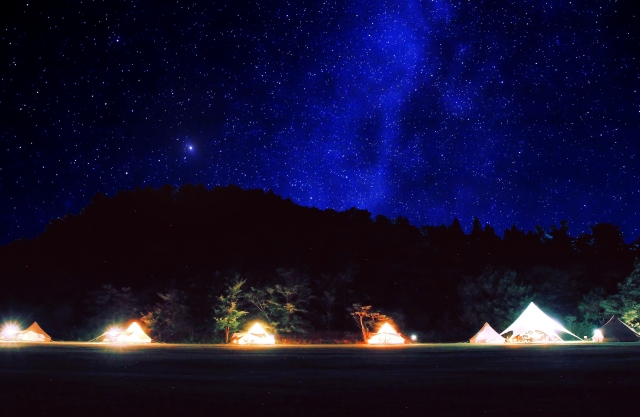
Mt. Sanbe’s Appeal:
- Elevation 600m+: Moderate height, accessible even in winter
- Campground available: Well-developed infrastructure including Sanbe Kitanohara Campground
- Hot springs: Relieve observation fatigue at Sanbe Onsen
Example Usage: Weekend, 2 nights at Mt. Sanbe Kitanohara Campground parking lot. First night planetary observation (Jupiter’s Great Red Spot, Saturn’s rings), second night meteor shower observation. During the day, enjoy astronomical exhibits at Sanbe Nature Museum Sahimel, and in the evening visit Sanbe Onsen. An ideal spot combining observation and sightseeing.
Sahimel Observatory: Has a 60cm aperture reflecting telescope, available on public days (check in advance).
Best Season: Year-round (relatively good access even in winter)
[Yamaguchi Prefecture] Diverse Observation Styles
🌌 Akiyoshidai Plateau
Estimated SQM Value: 20.5-21.0
Camping Car Suitability: ★★★★★
Akiyoshidai in Mine City is one of Japan’s largest karst plateaus. The 360-degree view and moderately open environment are ideal for observation.
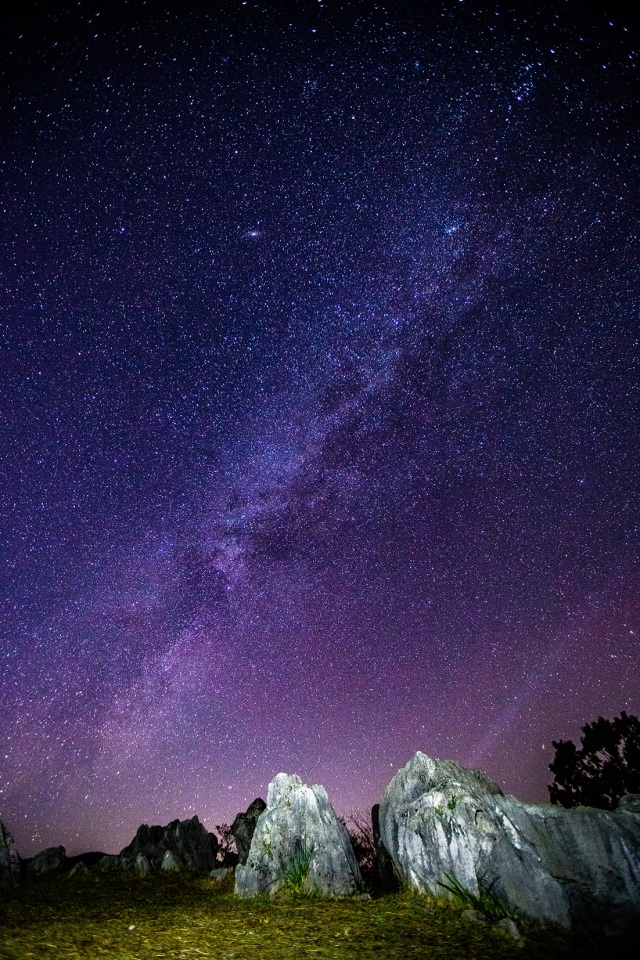
Akiyoshidai Characteristics:
- Large parking lots: Large parking areas around Karst Observatory
- Good access: 15 minutes from Mine IC on Chugoku Expressway
- Wind protection: Wind can be strong on the plateau. With a camping car, indoor observation is possible
Actual Observation Experience: Late September, visited for planet parade observation (Jupiter, Mars, Uranus, Saturn, Neptune). Parked the camping car at Akiyoshidai Karst Observatory parking lot and began observation at 8 PM.
Jupiter and Saturn lined up in the western sky, and confirmed the blue-green color of Uranus through binoculars. Thanks to autumn’s stable atmosphere (good seeing), even the gap in Saturn’s rings (Cassini Division) was visible through the telescope. When the wind got strong, retreated inside the vehicle and continued observation through the window.
Nearby Facilities:
- Akiyoshido Cave (sightseeing)
- Michi-no-Eki Mitou (overnight stay possible)
- Akiyoshidai International Art Village (accommodation available)
Best Season: Year-round (cold weather protection essential in winter)
🏨 Otani Sanso Astronomical Dome (Nagato City)
Camping Car Suitability: ★★★
“Otani Sanso,” a luxury ryokan in Yumoto Onsen, has an astronomical dome for guests.
Luxury Astro Tourism: It’s a bit unusual for camping car travelers, but worth considering for anniversaries or special events. You can experience a luxurious stargazing experience combining hot springs and professional-grade telescopes.
How to Use: Apply for astronomical dome use when making accommodation reservations
[Tottori Prefecture] Two Major Observation Sites: Daisen and Sand Dunes
🏔️ Mt. Daisen Area
Estimated SQM Value: 20.5-21.0
Camping Car Suitability: ★★★★ (summer)
The area around Mt. Daisen (1,729m), the highest peak in the Chugoku region, offers observation sites taking advantage of high elevation.
Summer Campground Bases:
- Mori no Kuni (Daisen Town)
- Daisen Masumizu Highland Sky Resort
- Masumizu Highland Campground
Using these campgrounds as bases, enjoy stargazing at night and mountain climbing or hiking during the day.
Notes:
- Snow in winter: Possible road closures from November to April
- Rapidly changing weather: Pay attention to mountain weather
- Road information check essential
Best Season: June to October
🏖️ Tottori Sand Dunes Area
Camping Car Suitability: ★★★★
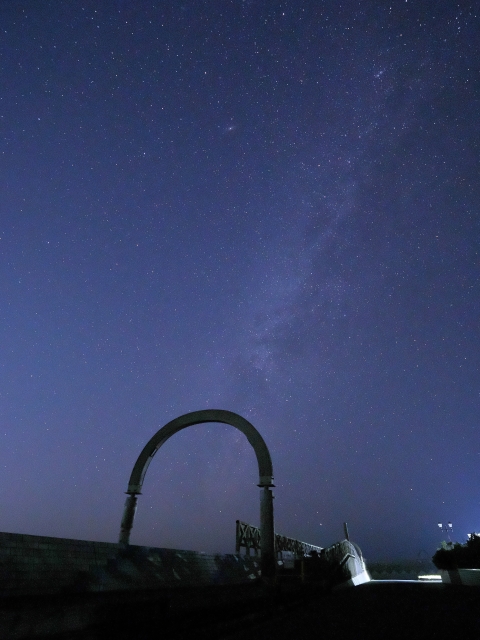
Tottori Sand Dunes offers a unique location with a completely open northern horizon.
Observation Advantages:
- Northern sky opens up: Cassiopeia, DSO observation around Polaris
- Easy access: Easy to respond to unexpected meteor shower peaks
- Parking available: Tottori Sand Dunes Parking Lots 1-3
Actual Usage Scene: Early January, peak day of the Quadrantids meteor shower. The radiant point is low in the northern sky. Park the camping car at Tottori Sand Dunes Parking Lot 2 and climb onto the dunes. With the view opening toward the Sea of Japan to the north, you won’t miss even low-altitude meteors.
Note: Dew prevention measures essential since it’s coastal. Bring lens heaters and hair dryers.
Seasonal Observation Planning Guide
🌠 2026 Seasonal Stargazing Planning Guide
Exploring the starry skies of Kinki and Chugoku regions with a camping car
Main Event: Quadrantids Meteor Shower (around 1/4)
📍Recommended Spots
- Oishi Highland (Wakayama)870m elevation
Stars shine even brighter in winter’s clear air. 360-degree panoramic view. Temperatures drop to near freezing, so full cold protection is essential. - Nishi-Harima Astronomical Observatory (Hyogo)
Accommodation available. Detailed observation of M42 possible with the “Nayuta” telescope. A valuable spot to use professional equipment indoors in the cold. - Bisei Town (Okayama)SQM 21.5+
Winter transparency × extremely low light pollution creates Japan’s top observation environment. Plan self-contained observation trips.
🌟Observation Targets
- Orion Nebula (M42)
In winter’s dry air, even the gas structures of the nebula are clearly visible. Beautiful even with binoculars. - Pleiades Star Cluster (M45/Subaru)
A cluster of blue-white young stars. 6-7 can be confirmed with the naked eye. - Winter Milky Way
The faint Milky Way flowing from Orion to Canis Major. Clearly visible at high elevations. - Quadrantids Meteor Shower (ZHR 80)
Peak around 1/4. Late night to dawn is crucial. The radiant point is near the handle of the Big Dipper.
🎒Camping Car Equipment
- Diesel Heater – Lifeline for vehicle heating. Sub-zero temperatures at elevations over 800m
- Full cold weather gear set – Down jacket, gloves, knit cap, neck warmer
- Hot drinks – Hot coffee or cocoa in a thermos. Warm your body from the inside
- Blankets/hot water bottles – For naps inside the vehicle. Electric blankets also recommended
- Studded tires/chains – High likelihood of snow and ice at highlands
- Extra fuel – Fuel consumption increases with heating. Keep plenty in reserve
⚠️Precautions
- Temperatures drop to sub-zero at elevations over 800m. Can go below -5°C at Oishi Highland
- Studded tires or chains required
- Check road closure information until just before departure (possible closures due to snow)
- Some areas have no cell signal. Share your plans with family beforehand
- Quadrantids peak is short. Secure backup days in case of bad weather
Main Events: Lyrids Meteor Shower (around 4/22) Planet Parade (mid-June)
📍Recommended Spots
- Nishi-Harima Astronomical Observatory (Hyogo)
Ideal for spring galaxy observation. Track faint galaxies with the 60cm telescope. Stay overnight to observe late into the night. - Tonomine Highland (Hyogo)800m elevation
Wide field of view secured. Observe the faint parts of the Milky Way along with the Spring Triangle. Also good for meteor shower observation. - Akiyoshidai (Yamaguchi)
Western horizon opens up. Advantageous for observing the June planet parade (evening western sky). Large parking lot on the karst plateau.
🌟Observation Targets
- Virgo Cluster
A massive galaxy cluster containing thousands of galaxies. Sweeping with a telescope reveals galaxies one after another. - Coma Cluster
Representative spring galaxy observation target. Don’t miss M64 (Black Eye Galaxy) either. - M51 (Whirlpool Galaxy)
A galaxy with beautiful spiral structure. Interacting with a smaller neighboring galaxy. - Mid-June Planet Parade
Jupiter, Venus, and Mercury line up in the evening western sky. Enjoyable even with binoculars. - Lyrids Meteor Shower (ZHR 18)
Peak around 4/22. Although meteor numbers are low, you can enjoy it alongside spring constellations.
🎒Camping Car Equipment
- Light cold weather gear – Nights are still around 10°C in spring. Fleece or windbreaker
- Dew prevention gear – Lens heater, hair dryer. Dew forms easily in this season
- Telescope (high magnification capable) – At least 15cm aperture recommended for galaxy observation
- Star chart app – Confirm galaxy positions with SkySafari, Stellarium
- Red LED light – Essential for maintaining dark adaptation
💡Observation Tips
- Galaxies are very faint. At least 30 minutes needed for dark adaptation
- Use low telescope magnification (50-100x) for a wider field of view
- At Nishi-Harima Observatory, you can get advice from professional staff
- June planet parade – First hour after sunset is crucial. Check low western sky
Most Important Event: Perseid Meteor Shower (8/13・Moon Phase 0)
Key Observation Date: Late night August 12 to dawn August 13
🏆Must-Visit Spots TOP 6
- 1. Bisei Town Starry Sky Park (Okayama)SQM 21.5+
Top-class darkness in Japan. Observe faint meteors with new moon × extremely low light pollution. 101cm telescope also available. - 2. Tonomine Highland (Hyogo)800m elevation・360°
Panoramic view with nothing blocking. Ideal for meteor shower observation. Easy access, 1 hour from Himeji. - 3. Soni Highland (Nara)800m elevation
Open grassland with full sky view. Also enjoy summer Milky Way observation at the same time. - 4. Oishi Highland (Wakayama)870m elevation
Highest class elevation in Kinki. Clear air, stars shine bright. 360-degree view secured. - 5. Oki Islands (Shimane)SQM 21.5+・Remote island
Completely isolated from Honshu light pollution. Ultimate dark sky. Ferry required but worth the trip. - 6. Mt. Osorakan Area (Hiroshima)1,300m class elevation
Hiroshima Prefecture’s highest peak area. Also ideal for observing the Milky Way center (Sagittarius).
⏰August 12-13 Observation Schedule
- 🕕 August 12, 6:00 PM – Arrive at location, begin setup
- 🍽️ 7:00-8:00 PM – Dinner, final equipment check
- 🌆 8:00 PM – Begin dark adaptation (red light only)
- ⭐ 10:00 PM – Begin observation (radiant point starts rising)
- 🌠 2:00-4:00 AM – **GOLDEN TIME** (radiant point at highest)
- 🌅 5:00 AM – Final meteor observation before dawn
- ☕ 6:00 AM – Breakfast inside vehicle, nap
- Faint meteors visible to naked eye (normally invisible!)
- Milky Way clearly visible (especially dense toward Sagittarius)
- Chance to observe M8 (Lagoon Nebula), M20 (Trifid Nebula) simultaneously
🌟Observation Targets
- Perseid Meteor Shower
ZHR 100+ expected Best observation chance in history with new moon conditions. 50+ meteors per hour possible. - Milky Way Center (toward Sagittarius)
Densest part of the summer Milky Way. Nebulae including M8, M20, M17 densely packed. - Antares in Scorpius
Bright red 1st magnitude star. Globular cluster M4 also nearby. - Early August Planet Parade
Mercury, Mars, Uranus, Saturn, Neptune line up in the dawn eastern sky.
🎒Camping Car Equipment
- Long sleeves/light fleece – Nights drop to around 15°C at elevations over 800m
- Insect repellent spray – Mosquitoes and gnats common in mountain areas. Essential
- Wide-angle lens (14-24mm) – Ideal for star landscape photos, time-lapse
- Leisure sheet/hammock – Lying down to watch meteors is the best way
- Extra batteries – Prepare for camera, smartphone battery depletion
- Red LED headlight – Convenient with hands free
- Planisphere – To confirm radiant point
📸Photography Tips
- Wide-angle lens (14-24mm), F2.8 or faster
- ISO 3200, shutter speed 15-20 seconds
- Interval shooting: continuous shots at 5-second intervals
- Tripod essential. Hang weight for wind protection
- With 2 hours of shooting, high probability of capturing 20-30 meteors
Main Events: Planet Parades (September & November) Geminids Meteor Shower (mid-December)
📍Recommended Spots
- Nishi-Harima Astronomical Observatory (Hyogo)
Ideal for high-magnification planetary observation. Autumn’s stable atmosphere allows you to see gaps in Saturn’s rings. - Otani Sanso Astronomical Dome (Yamaguchi)
Good seeing conditions. A luxurious experience combining hot springs and observation. - Soni Highland (Nara)Famous for pampas grass
Collaboration of autumn pampas grass and starry sky. Best location for photography. - Akiyoshidai (Yamaguchi)
Stable autumn atmosphere. Best environment for planetary observation. Large parking lot is also attractive.
🌟Observation Targets
- Andromeda Galaxy (M31)
Representative autumn galaxy. Faintly visible to the naked eye. Elliptical shape visible through binoculars. - Triangulum Galaxy (M33)
Faint but beautiful spiral galaxy. Best enjoyed under dark skies. - Pleiades Star Cluster (M45)
Rises high from autumn to winter. Cluster of blue-white young stars. - Late September Planet Parade
Jupiter, Mars, Uranus, Saturn, Neptune. Observable from evening to midnight. - Late November Planet Parade
Mercury, Venus, Mars, Jupiter, Uranus. Line up in the early morning eastern sky. - Geminids Meteor Shower (ZHR 80)
Peak mid-December. Beautiful meteors visible in winter’s clear sky.
🔭Why Autumn Observation is Advantageous
- Summer heat subsides, atmospheric turbulence decreases
- Planetary details (Jupiter’s Great Red Spot, gaps in Saturn’s rings) are easier to see
- Images remain sharp even at high magnification (200-300x)
- Seto Inland Sea side has particularly high clear sky rates
- Faint planets like Uranus and Neptune are easier to capture
🎒Camping Car Equipment
- Moderate cold weather gear – Light in October, winter gear for Nov-Dec
- Telescope (high magnification capable) – 20cm aperture or larger recommended for planetary observation
- Planetary camera – Video capture and stacking processing for high resolution
- Camera tripod – For pampas grass and starry sky photography
- Barlow lens – For boosting magnification in planetary observation
📸Autumn-Specific Photography Techniques
- Dusk: Pampas grass glows gold in the sunset (before blue hour)
- Blue hour: Sky turns deep blue, pampas grass becomes silhouette
- Complete darkness: Combine starry sky with pampas grass foreground
- Wide-angle lens (14-24mm), F2.8, ISO 3200, 20-30 second exposure
- Light painting technique with LED light on pampas grass is also effective
Practical Tips for Stargazing with a Camping Car
🚐 Stargazing with a Camping Car: Practical Tips
Complete guide useful in the field, from preparation to safety measures
Essential Equipment
- Red LED Light (low brightness) Essential for maintaining dark adaptation. White light is absolutely not allowed. Headlight type is convenient as it keeps hands free.
- Planisphere or Smartphone App SkySafari and Stellarium recommended. Download in advance for offline use.
- Leisure Sheet Lying down is the best way to watch meteor showers. Use a thick one to block cold from the ground.
- Cold Weather Gear (according to season) Nights are around 15°C even in midsummer at elevations over 800m. Sub-zero in winter. Layering is fundamental.
- Binoculars (7×50 or 10×50 recommended) For observing star clusters, nebulae, comets. Best magnification that can be held by hand.
Nice to Have
- Telescope For beginners: 8cm aperture refractor or 15cm reflector. Can also observe planets and moon craters.
- Camera & Tripod For star landscape photos, time-lapse. Wide-angle lens (14-24mm) and F2.8 or faster recommended.
- Lens Heater Essential for dew prevention. USB-powered type is convenient. Can also be used on telescope eyepieces.
- Portable Power Station For charging camera, smartphone, heater. 500Wh capacity or more recommended.
- Hot Drinks (Thermos) Emotional support for winter night observation. Warm your body with hot coffee or cocoa.
Camping Car Advantages
- Easy transport of heavy equipment (telescope, tripod, full camera gear)
- Prepare and adjust equipment inside the vehicle
- Immediately warm up inside when cold
- Secured rest space during observation
- Shelter during unexpected weather deterioration
🌙 Apply Bisei Town Rules at All Spots
Bisei Town in Okayama Prefecture has enacted a “Light Pollution Prevention Ordinance” to protect top-class dark skies in Japan. These rules are etiquette that should be followed at all observation sites, not just Bisei Town.
- White Light Use Prohibited
Flashlights, smartphone lights, car headlights – white light instantly destroys the dark adaptation of surrounding observers. Never use them. - Use Red LED Lights at Minimum Brightness
Red light has less impact on dark adaptation, but too bright is still bad. Adjust to minimum brightness, just enough to light the ground. - Turn Off Car Headlights Away from Observation Area
Turn off lights at least 50m away from observation area when parking. Move only with red light after arrival. - Be Considerate of Other Observers
If arriving late and others are already observing, be quiet. Close car doors quietly. Keep voices down. - Set Smartphone Screen Brightness to Minimum
Even when using constellation apps, set screen brightness to minimum. Use night mode (red display) if available.
Why Be So Thorough
Human eyes need at least 30 minutes for dark adaptation (getting used to darkness and being able to catch faint light). However, dark adaptation is completely lost with a moment of white light, requiring another 30 minutes to dark adapt again. At extremely low light pollution sites like Bisei Town, the number of stars visible with dark-adapted eyes is more than 10 times that of unadapted eyes. This difference is overwhelming.
⛰️ Mountain Area Observation
- Check Weather Forecast Until the Last Minute
Mountain weather changes quickly. Check 3 times: before departure, before arrival, before starting observation. Japan Meteorological Agency’s “High-Resolution Precipitation Nowcast” is useful. - Some Areas Have No Cell Signal
Share with family “when, where, and who you’re going with” before departure. Also communicate expected return time. - Emergency Communication System
Two-way radios are convenient when going in multiple vehicles. Satellite phones for serious expeditions. - Food and Water Reserves
No convenience stores in mountain areas. Carry at least 1 day’s food and 2L of water. Don’t forget emergency food. - Carry First Aid Kit
Keep a kit for scrapes, insect bites, sprains, and other minor injuries in the vehicle at all times.
❄️ Winter Observation
- Studded Tires or Chains Required
Highlands over 800m elevation may have snow and ice from November to April. Never go with normal tires. - Keep Plenty of Fuel
Fuel consumption increases with diesel heater use. Leave with a full tank and refuel when half empty. Running out of fuel is life-threatening. - Snow/Ice Escape Equipment
Keep shovel, tow rope, traction mats (boards to place under tires) on hand. Self-rescue is fundamental when stuck in snow. - Thorough Cold Protection
Sub-zero at elevations over 800m. Down jacket, gloves, knit cap, hand warmers, blankets are essential. Hypothermia is life-threatening. - Beware of Carbon Monoxide Poisoning
Ventilation is essential when using diesel heater inside the vehicle. Periodically check that the exhaust port is not blocked by snow.
☀️ Summer Observation
- Heat Stroke Prevention (During Daytime Travel)
Stay hydrated with water and salt, use air conditioning. Interior temperatures can exceed 50°C especially in August daytime. Take frequent breaks. - Insect Protection
Mountain areas have many mosquitoes, gnats, and horseflies. Defend with insect repellent spray, mosquito coils, long sleeves and pants. Keep anti-itch cream for bites. - Even High Elevations Get Cold at Night
Even in midsummer, nights drop to around 15°C at elevations over 800m. Always bring long sleeves and light fleece. - Beware of Thunderstorms and Sudden Downpours
Mountain areas commonly have thunderstorms from afternoon to evening in summer. Retreat inside the vehicle immediately when thunder is heard. - Bear and Wild Boar Precautions
Wild animals inhabit mountain areas. Don’t leave food outside. Carry bear bells and whistles. If encountered, retreat quietly.
Emergency Decision Criteria
- ⚡ Thunder starts → Immediately stop observation, retreat inside vehicle
- 🌧️ Visibility drops below 100m → Stop driving, wait in safe location
- ❄️ Can’t see ahead in blizzard → Stop on roadside, turn on hazard lights
- 🌡️ Body starts shivering → Sign of hypothermia, immediately get warm
- 📵 No cell service and feeling unwell → Don’t push it, descend mountain, move to populated area
💧 Dew is the Enemy When Observing at Coasts and Highlands
Dew occurs when water vapor in the air liquefies on the surface of cold objects (lenses, telescope tubes, etc.) as temperature drops. Humidity is high especially along coasts (Cape Shionomisaki, Lake Biwa shore, Sea of Japan side) and highland nights, creating conditions where dew easily forms. When telescope or camera lenses fog up, observation becomes impossible.
- Lens Heater (wrap around telescope, camera lens)
Most effective countermeasure. Keeps lens temperature above dew point, preventing dew. USB-powered type can be powered from portable battery. Wrap before starting observation. - Hair Dryer (use with portable power station)
Emergency treatment when dew has already formed. Dry slowly with low-temperature air. Hot air may damage optical systems, so be careful. - Towels (to wipe equipment)
Microfiber towels are best. Don’t scratch lens surfaces and have high absorbency. Bring multiple and replace when wet. - Store Inside Vehicle (when not observing)
During breaks and meals, move equipment inside. Minimize time exposed to outside air. Especially at dawn when temperature drops sharply and dew becomes severe. - Silica Gel (desiccant)
Put silica gel in equipment cases. Effective for moisture prevention during storage. - Use Dew Shields
Attach a dew shield (light shield tube) to telescope front. Prevents dew from falling directly on the lens.
Conditions Where Dew Easily Forms
- 🌊 Coastal areas (Cape Shionomisaki, Lake Biwa shore, Sea of Japan side) – Constantly high humidity
- 🏔️ Highland pre-dawn – Temperature drops sharply
- 🌧️ Night after rain – Humidity rises from ground evaporation
- ☁️ Sudden clearing after cloudy sky – Temperature drops sharply from radiative cooling
- 🍂 Autumn (Sep-Nov) – Large day-night temperature difference
Dew Prevention Don’ts
- ❌ Rapid drying with hot hair dryer → Lens coating may peel
- ❌ Wiping with tissue → Fibers stick to lens, causes scratches
- ❌ Continuing observation with dew formed → Moisture enters lens interior, causes mold
- ❌ Wiping with alcohol → Coating may dissolve
📦 Dew Prevention Kit (Recommended to Keep in Vehicle)
- ✓ Lens Heater ×2 (for telescope and camera)
- ✓ Microfiber Towels ×3 (always have dry ones ready)
- ✓ Portable Power Station (for heater power, 500Wh or more)
- ✓ Small Hair Dryer (for emergency treatment)
- ✓ Silica Gel (for equipment cases)
- ✓ Plastic Bags (protect equipment from sudden rain)
2026 Annual Observation Plan Sample
[Winter Expedition] January 3-5: Quadrantids Meteor Shower
- Destination: Oishi Highland (Wakayama)
- Route: Osaka → Wakayama City → Aridagawa Town (about 2 hours)
- Observation: Late night January 4 to dawn
- Backup Day: January 5 (in case of bad weather)
- Equipment: Diesel heater, cold weather gear, hot drinks
[Spring Expedition] Late April: Lyrids Meteor Shower + Spring Galaxy Clusters
- Destination: Nishi-Harima Astronomical Observatory (Hyogo)
- Observation: Around April 22, using accommodation facilities
- Daytime: Participate in observation sessions, view exhibits
- Nighttime: Meteor observation + galaxy observation with 60cm telescope
[Summer Showdown] August 11-14: Perseid Meteor Shower
- First Choice: Bisei Town Starry Sky Park (Okayama)
- Second Choice: Tonomine Highland (Hyogo)
- Key Observation Date: Late night August 12 to dawn August 13
- Equipment: Wide-angle lens, time-lapse equipment, leisure sheet
- Budget: Gas, food (3 nights 4 days)
- Backup Days: August 13, 14
[Autumn Expedition] Late September: Planet Parade + Pampas Grass
- Destination: Soni Highland (Nara)
- Daytime: Stroll through the sea of pampas grass, photography
- Evening to Night: Planet parade observation (Jupiter, Mars, Uranus, Saturn, Neptune)
- Equipment: Telescope (high magnification), planetary camera
[Winter Expedition] Mid-December: Geminids Meteor Shower
- Destination: Akiyoshidai (Yamaguchi)
- Observation: Around peak day
- Nearby Sightseeing: Akiyoshido Cave tour
- Equipment: Full cold weather gear, diesel heater
🌌 Kinki-Chugoku Stargazing FAQ
Conclusion: 2026 is a Great Year for Stargazing Trips
2026 presents a once-in-a-decade opportunity for astronomy fans, with the Perseid meteor shower coinciding with a new moon. Additionally, the Public Astronomical Observatory 100th Anniversary Project (November 2025 – March 2027) will have observatories across the country holding special events.
With a camping car:
- Transport equipment to the best observation sites
- Rest and stay overnight inside the vehicle
- Shelter during sudden weather changes
- Self-contained with no facility constraints
The Kinki and Chugoku regions are a treasure trove for stargazers, with dark skies of SQM 21+ scattered within 2 hours of urban centers. Particularly Bisei Town, Tonomine Highland, Oishi Highland, and the Oki Islands boast top-class darkness in Japan.
Late night August 12, 2026, observing the new moon Perseid meteor shower under pristine dark skies. This will be an experience of a lifetime.
Start planning now to fully enjoy the starry skies of 2026. A stargazing trip with a camping car is the ultimate outdoor experience where observation and adventure become one.
Clear Skies!
※Please be sure to check the operating status of each facility and road conditions in advance. Especially in winter, mountain areas may be closed due to snow and ice.
※Follow local rules at observation sites and always take your trash home. To preserve beautiful starry skies for future generations.